The Indian school education system has a rich history. The diversity of cultures and languages adds vastness and complexity to our educational landscape. Even though our education system has gained respectable recognition around the world, it’s still riddled with various challenges.
Despite several changes made to our system, many issues persist.
It has become essential to address them as millions of lives are impacted by the Indian education system. Here, we will discuss the Indian school education system in detail, along with an analysis of the major challenges and how to resolve them. Keep reading ahead!
Quick Glance at the Blog
We have created a tabular overview detailing various sections of the write-up, such as the overview of the education system of India, its challenges and possible solutions. We hope navigation becomes smoother through this format. Read below!
| Sections | Details |
| Overview of the School Education System in India | Read the overview of the Indian education system. |
| What challenges does the school education system in India face? | Struggles associated with the Indian education system. |
| What are the possible solutions for these problems? | Possible solutions to the struggles associated with the Indian education system. |
| Conclusion | Concluding paragraph of this write-up. |
| Frequently Asked Questions | Answers common questions on the education system of India. |
Overview of the School Education System in India
The Indian school education system has seen various changes and has undergone major transformation over the years. For instance, there is a lot of difference between pre- and post-colonial British rule.
Earlier, children used to receive traditional forms of education from the Gurukuls. Today, we have adopted a modern education system in which the right to education has become a fundamental right. The school education system is wide and intricate. It’s divided into 4 levels, namely pre-primary, primary, upper-primary and secondary.
They are overseen by 3 national bodies: the All India Council for Technical Education (AICTE), the University Grants Commission (UGC), and the National Council of Educational Research and Training (NCERT). If we talk about the types of schools in the country, they can be categorised as government-run, private-run, international and boarding schools, etc.
All these schools are associated with boards of education such as the Central Board of Secondary Education (CBSE), State Boards, the Indian Certificate of Secondary Education (ICSC), the International Baccalaureate (IB), and the National Institute of Open Schooling (NIOS). In the next section, we focus on the significant issues faced by our education system.
What challenges does the school education system in India face?
The right to education is a fundamental right under Section 21-A of the Constitution of India. According to this provision, every child aged 6-14 has the right to receive free and compulsory education. However, one of the biggest challenges we face today is access to quality education.
The school education system requires many changes due to issues such as corruption, inadequate infrastructure, poor quality, and a lack of enthusiasm for improvement. Let’s first look at some of these current challenges.
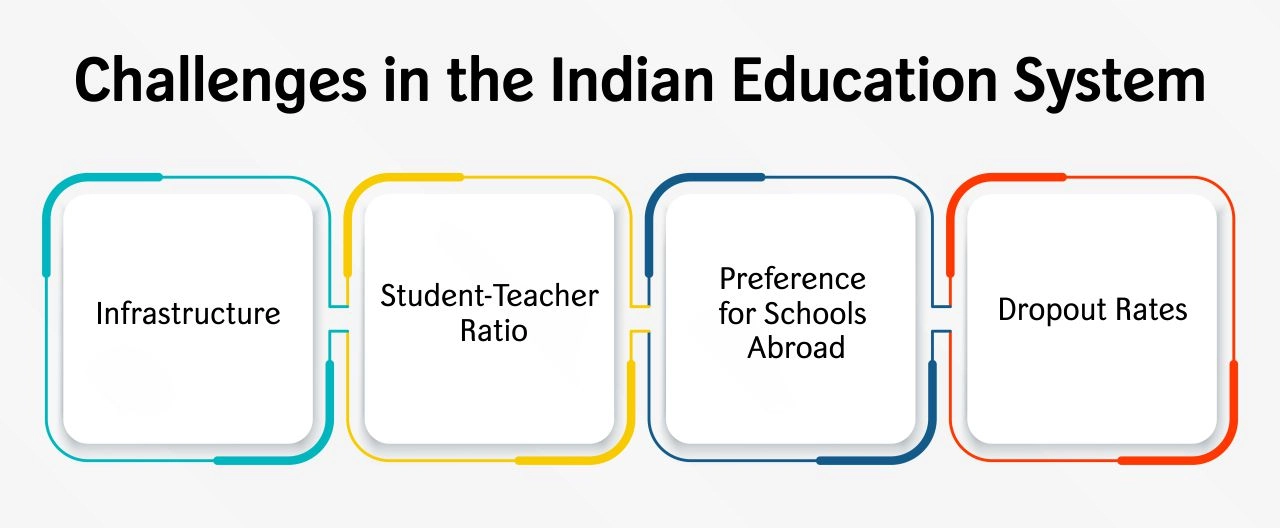
Infrastructure
One of the biggest issues we face today is the lack of infrastructure in schools. Many schools lack proper sanitation and hygiene facilities, with inadequate toilets and drinking water access, which affects students’ health and attendance. Additionally, poor classroom conditions, insufficient furniture, and the absence of libraries, laboratories, and digital resources hinders effective learning.
Student-Teacher Ratio
It’s no secret that, despite thousands of B. Ed. graduates, the country has a shortage of qualified teachers. Due to these factors, the student-teacher ratio is disproportionate.
Preference for Schools Abroad
Another problem that has recently popped up is the preference for foreign schools. Due to inadequate facilities and other challenges in the country, financially well-off parents choose to send their children abroad for education.
Dropout Rates
The dropout rates are pretty high at primary and secondary levels. Whether due to poverty, patriarchal norms, or other socio-economic barriers, many students give up school.
What are the possible solutions for these problems?
Over the years, the Indian government started various initiatives to assuage the problems faced by the education system of India. However, despite these efforts, there is still room for improvement. Let’s explore how.
- The first step should be to increase the funds allocated to education.
- The school curriculum should develop decision-making skills and critical thinking among students.
- Vocational training should be included in the mainstream education system.
- Both rural and urban areas should get a quality level of education.
- Private schools charge exorbitant fees to provide quality infrastructure and education, while government schools are affordable but lack such facilities. So this disparity should be addressed, and affordable education should be made available.
| Challenges | Solutions |
| Lack of Infrastructure | Develop proper classrooms, toilets, drinking facilities, libraries, etc. |
| Teacher Shortage | Provide high-quality teacher training programmes. |
| Student-Teacher Ratio | Recruit qualified teachers |
| Rote Learning | The approach should shift to critical thinking and problem-solving skills. |
| Language Barrier | Education should be available in regional or bilingual languages. |
| Unequal Access | Underprivileged children should have access to free and quality education. |
Conclusion
The school education system in India plays a critical role in moulding the future. Even though we face various challenges, we can address them with comprehensive changes. Considered among the top 5 schools in Vikaspuri Delhi, K.R. Mangalam World School is committed to redefining education.
With state-of-the-art facilities, a quality curriculum and a nurturing environment, the best pre nursery school in Vikaspuri empowers students to become their best versions. Join us now! You can check the latest CBSE school fees West Delhi.
Frequently Asked Questions
Who manages the school education system in India?
The Ministry of Education (MoE) of India manages the school education system.
How does the school education system work in India?
The Indian school system has 4 levels, including pre-primary, primary, upper primary and secondary.
What are the different types of school boards in India?
The formal boards of education in India include the Central Board of Secondary Education (CBSE), State Boards, the Indian Certificate of Secondary Education (ICSC), the International Baccalaureate (IB) and the National Institute of Open Schooling (NIOS).
Does the public and private school education system in India follow the same curriculum?
Both the public and private schools follow the national curriculum. However, as compared to public schools, private ones can be flexible enough to incorporate a specialised curriculum.
Mehak Reejonia
content writerMehak is a creative writer with over five years of experience crafting content across diverse industries. A Political Science graduate with a keen analytical mind, she brings precision, research rigor, and an eye for detail to everything she writes. At K.R. Mangalam Schools and University, she is currently handling blogs, on-page and off-page content, brand communications, SEO metadata, etc. When she's not busy typing her worries away, you'll find her deeply immersed in her screen, chasing the right word.