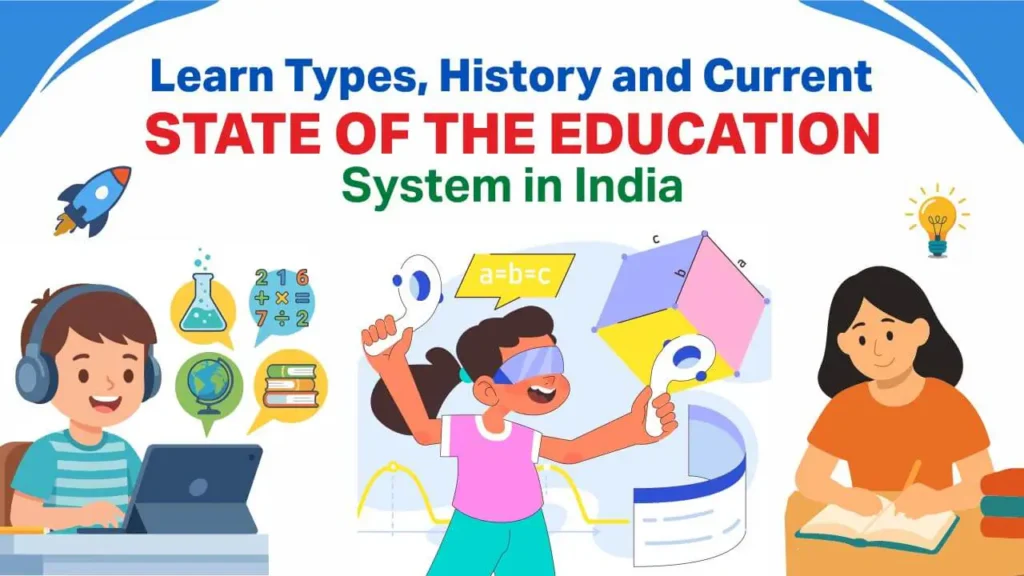
The education system in India is one of the largest in the world, as it caters to more than 240 million students. So the magnitude and impact of the system are highly decisive for the country’s future. The importance of the education system cannot be taken for granted, as it not only shapes the youth but also the country’s future. It allows an individual to acquire knowledge and skills, apply them and live life to the best of their potential.
India’s education system affects millions of lives, and yet it’s marred with various challenges and complexities. In today’s write-up, we will discuss the complexities of Indian education, along with a brief history and the current state we are in. Let’s begin!
History of the Education System in India
The history of the education system in India is both vast and millennia old. In the Vedic period, there was an intricate relationship between a guru or a prabhu (teacher) and a shishya (student) in an ashram setting. This Gurukul era of learning placed importance on both teachers and students, and the idea of education was to learn core concepts like maths, science, literature, spiritual learning, philosophy, and analytical/logical concepts. In fact, the focus was to provide holistic education by developing agricultural, military, pottery, weaving and other household skills.
Some of the oldest Indian universities include Takshashila and Nalanada Mahavihara. The medieval era saw the introduction of the Delhi Sultanate and the Islamic school of teaching with maktabs and madrasas. The next major transition was seen during the British colonial era. During this time, British rule aimed to dismantle the indigenous teaching and village schools and establish an anglicised system that promoted the English language over Sanskrit, Urdu and other regional languages.
Post the colonial rule, India’s education system had another transition, and we refocused on indigenous teaching with a strong focus on elementary and higher education. Now again, we are in a new phase. We will discuss the current education system ahead.
Types of Education Systems in India?
Primarily, there are two types of education systems in India. The first and most followed is formal education. This type of education is acquired in public or private schools, colleges and universities. These educational institutions have a structured academic system. On the other hand, informal education lacks a formal setting, a curriculum and does not have a structured approach. The knowledge and skills can be acquired through internships, apprenticeships, workshops, media or training programmes.

Current Education System in India
Let’s discuss the current education system in India. The National Education Policy of India 2020 (NEP 2020) is the new education policy which is currently being implemented to replace the previous National Policy on Education, 1986. One of the biggest changes it proposed was replacing the breakdown of the education system. Previously, India followed a 10+2 approach. This is being replaced with a 5+3+3+4 system.
- Foundational Stage starts at age 3-8 and consists of Class 1-2
- Preparatory Stage covers Class 3-5
- Middle Stage covers Class 6-8
- Secondary Stage covers Class 9-12
K.R. Mangalam World School: Best School in Vikaspuri
The latest changes in the education system in India have led to a massive transformation. Many schools are still reeling and yet to follow the NEP 2020 guidelines, but K.R. Mangalam World School, Vikaspuri, is one of the few schools that has started following the NEP. The school’s curriculum is based on the NEP 2020, and the school has integrated activity-based learning, project-making and combining interactive technologies with experiential learning.
Admissions are open now!

Frequently Asked Questions
How is the education system of India?
The education system in India is one of the largest in the world, governed at the central, state, and local levels. It provides free and compulsory education to children under the Right to Education (RTE) Act, 2009, but still faces challenges such as unequal access and an exam-oriented learning approach.
What are the 4 types of education in India?
The four main levels of education in India are early childhood education, primary education, secondary education, and higher education.
What are the main problems with education in India?
Major challenges in India’s education system include rote learning, exam-oriented teaching, outdated curricula, and unequal access between rural and urban areas.
What are the 4 pillars of education?
The four pillars of education, proposed by UNESCO, are:
Learning to Know – gaining knowledge and understanding
Learning to Do – developing practical skills and competence
Learning to Live Together – promoting cooperation, empathy, and peace
Learning to Be – supporting personal growth and self-development
Which education system is best in India?
CBSE is one of the most preferred education boards in India due to its structured curriculum, national recognition, and focus on competitive exam preparation. More than 27,000 schools in India and abroad are affiliated with CBSE.