As the education industry is evolving, schools and colleges need to take advantage of adaptive learning. The classroom itself should create an environment that promotes learning, connection, and support. By doing so, students can learn faster and more efficiently.
Quick Glance At the Blog
We have created a tabular overview for readers to sift through various blog sections such as the meaning of adaptive learning, its related benefits, and challenges. We hope this readable format makes the reading process straightforward. Take a look below!
| Sections | Details |
| What is adaptive learning? | Learn the meaning of adaptive learning. |
| What are the key benefits of adaptive learning? | Brief explanation of the benefits of the adaptive learning approach. |
| What are the major challenges of adaptive learning? | Check out the challenges related to adaptive learning. |
| Conclusion | Concluding paragraph on this blog topic. |
| Frequently Asked Questions (FAQs) | Common questions related to adaptive learning. |
What is adaptive learning?
Adaptive learning is an educational method that uses digital platforms and artificial intelligence to manage interactions with students and deliver customised resources tailored to their needs.
In adaptive learning, the coursework progresses based on a student’s learning abilities. In today’s era, educational institutions are increasingly using technology to foster strong interactions with students and enhance learning.
Adaptive learning includes Artificial Intelligence (AI), Machine Learning (ML), and Computer Algorithms. Online learning is a useful tool, as it focuses mainly on the student’s grasping pace and is customised for each individual. In this method, coursework adapts based on a student’s learning abilities. As technology continues to evolve, adaptive learning fosters stronger student interactions and enhances educational outcomes.
What are the key benefits of adaptive learning?
The demand for adaptive learning has grown significantly, and new concepts of education have gained momentum, especially after the COVID-19 pandemic. Each student’s pace of acquiring knowledge is different, so adaptive learning can help create a personalised learning experience for them.
Today, adaptive learning has become a major part of the ed-tech industry, as it provides teachers and parents with a way to assess a student’s thinking and problem-solving abilities. Let’s explore some of the key benefits of adaptive learning.
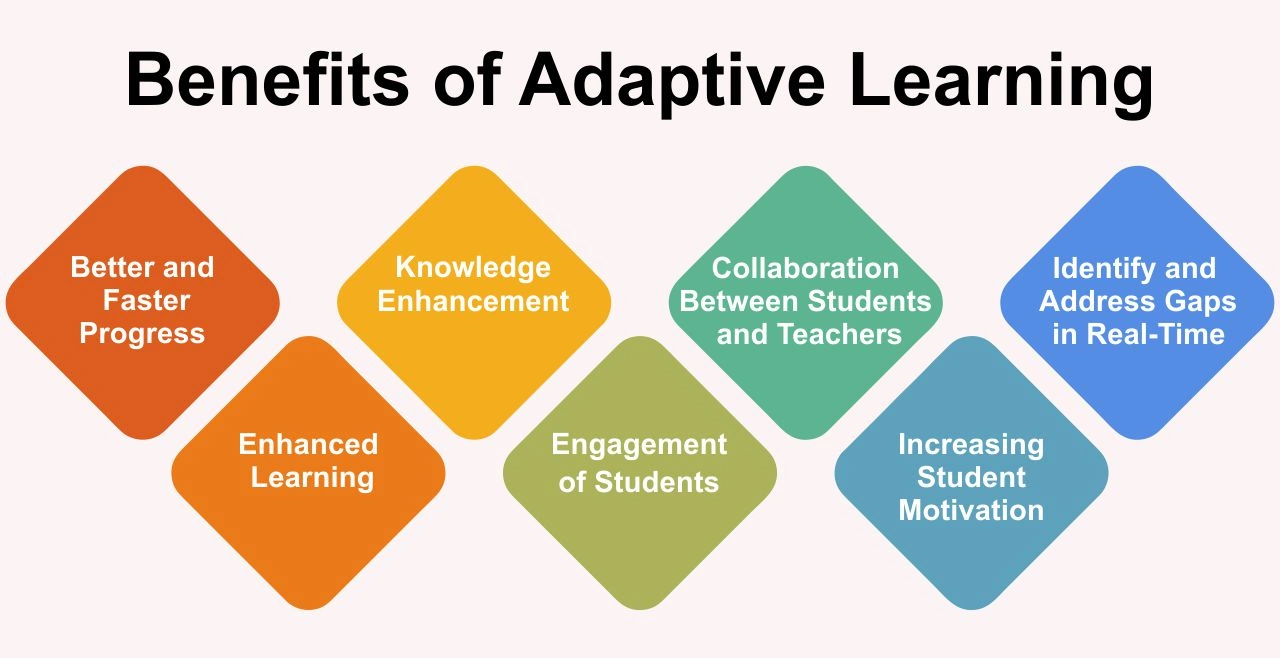
Better and Faster Progress
Increasing student enrolment and larger classrooms are some of the challenges students face in the traditional school system. To overcome these obstacles, adaptive learning can be useful. By using various educational platforms and apps, teachers can divide students into smaller groups based on their learning potential, thus giving each group enough attention.
Enhanced Learning
A major advantage of adaptive learning is that it can assess students’ strengths and weaknesses in real time based on their learning graphs. By optimising and customising education apps, students can gain a thorough understanding of a topic before moving on to more complex material.
Knowledge Enhancement
In a conventional classroom, it is hard for teachers to ensure that students understand the topic equally. By using advanced technological apps, teachers can create a personalised course of action. As a result, students are better prepared to grasp new information and can learn at their pace.
Engagement of Students
Today’s students use technologically advanced devices. The use of adaptive learning technology can leverage students’ love of technology. With the advent of mobile devices, students are more likely to engage with educational apps that facilitate their learning through tailored educational programmes. Learning becomes exciting and engaging through these apps, which provide an excellent level of immersion.
Collaboration Between Students and Teachers
The benefits of adaptive learning extend beyond mobile screens to blended learning as well. Conducting one-to-one sessions with students would provide them with all the insights they need. Additionally, it improves the efficiency and effectiveness of teachers in imparting education.
Increasing Student Motivation
By offering students more control over their learning process, adaptive learning makes them feel more empowered. They can choose which topic to learn at their own pace, without waiting for slower or faster peers. They gain confidence and learn more with this approach.
Identify and Address Gaps in Real-Time
In adaptive learning, the focus is primarily on student knowledge gaps, so identifying them is an important element of the strategy, which allows educators to address pain points. Moreover, this method allows for providing real-time feedback to students by analysing their academic performance and providing additional support when necessary.
What are the major challenges of adaptive learning?
There are several challenges that adaptive learning faces, which can limit its adoption by educational institutions. Some of them include:
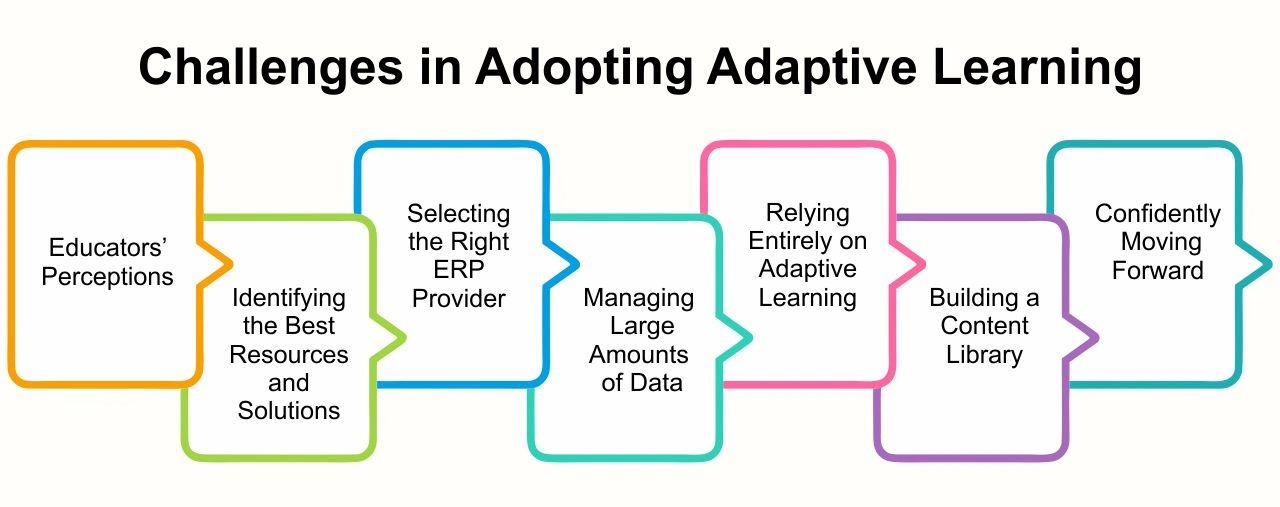
Educators’ Perceptions
Due to a lack of proper training, many educators are unwilling to change their teaching style. Furthermore, teachers generally believe that modern technologies leave students at the mercy of unreliable algorithms. According to them, using educational apps offers only a limited level of personalisation, so if learners have difficulty mastering a concept, they are likely to become discouraged.
Identifying the Best Resources and Solutions
In the absence of proper awareness and research, it can be expensive to offer education via adaptive learning. When designing an adaptive learning platform, you must consider several factors, including the right tools and the cost. Since there are many vendors on the market, institutions are taking a risk by using adaptive learning technology that is still unproven.
Selecting the Right ERP Provider
Educational institutions need to hire a team of developers or ERP providers who can help them transition to adaptive learning by providing user-friendly-to-use AI-based educational tools. With many adaptive learning platform providers, selecting the right vendor can be time-consuming and stressful.
Managing Large Amounts of Data
By utilising adaptive learning platforms and educational apps, teachers face additional tasks such as analysing the data. Based on the graphs and patterns generated, faculty have to make deductions. It is necessary to provide them with additional training so that they can analyse the data and draw conclusions effectively.
Relying Entirely on Adaptive Learning
There is a tendency among teachers to confuse adaptive learning with total replacement of teaching, but the teacher’s role is equally important. In some cases, algorithms may not be able to measure all aspects of learning. As part of the adaptive learning process, faculty still play a major role in designing and analysing the information generated by the technology and in helping students learn.
Building a Content Library
With adaptive learning, educators create multiple iterations of one-course topics, tailoring the content to the students’ needs. Active learning will be emphasised in some versions; visual learning will be in others; passive learning will be in others. For teachers, it can be a challenge to create different versions of content for students with different learning capabilities.
Confidently Moving Forward
Since adaptive learning is a new approach, and there are insufficient research studies to prove its effectiveness, there is some uncertainty in the education sector as to whether it should be accepted.
There are many schools that have spent a great deal of money developing algorithms for online adaptive learning platforms without fully understanding their implementation. Consequently, confusion and limitations have hampered this approach.
Conclusion
Institutes need to examine the above benefits and challenges associated with implementing adaptive learning technology before deciding to focus on supporting teachers in providing the best-customised learning experience for every single student. By doing so, they can reach more than one hundred students at once with the benefits of learning.
There are various schools in Vikaspuri, but only a few support an adaptive learning approach. Considered the top CBSE school Vikaspuri, K.R. Mangalam World School is among the few of them. This best school in Vikaspuri uses a variety of learning activities to achieve high learning outcomes synergistically. Our adaptive technologies support online learning, enabling each student to do activities tailored to their individual learning abilities.
Frequently Asked Questions (FAQs)
Q1. What is adaptive learning?
Adaptive learning refers to an educational method that uses digital platforms and artificial intelligence to manage interactions with students.
Q2. How does adaptive learning help students?
Each student’s pace of acquiring knowledge is different, so adaptive learning can help create a personalised learning experience for them.
Q3. What technology is used in adaptive learning?
Adaptive learning uses Artificial Intelligence (AI), Machine Learning (ML), and Computer Algorithms.
Q4. What is the limitation of adaptive learning?
Some challenges include teacher reluctance, managing data, and selecting the right tools.
Q5. What are some examples of adaptive learning?
Some examples of adaptive learning include Maths and STEM platforms like Dreambox and learning platforms like Duolingo, DIKSHA, PAL and more.